
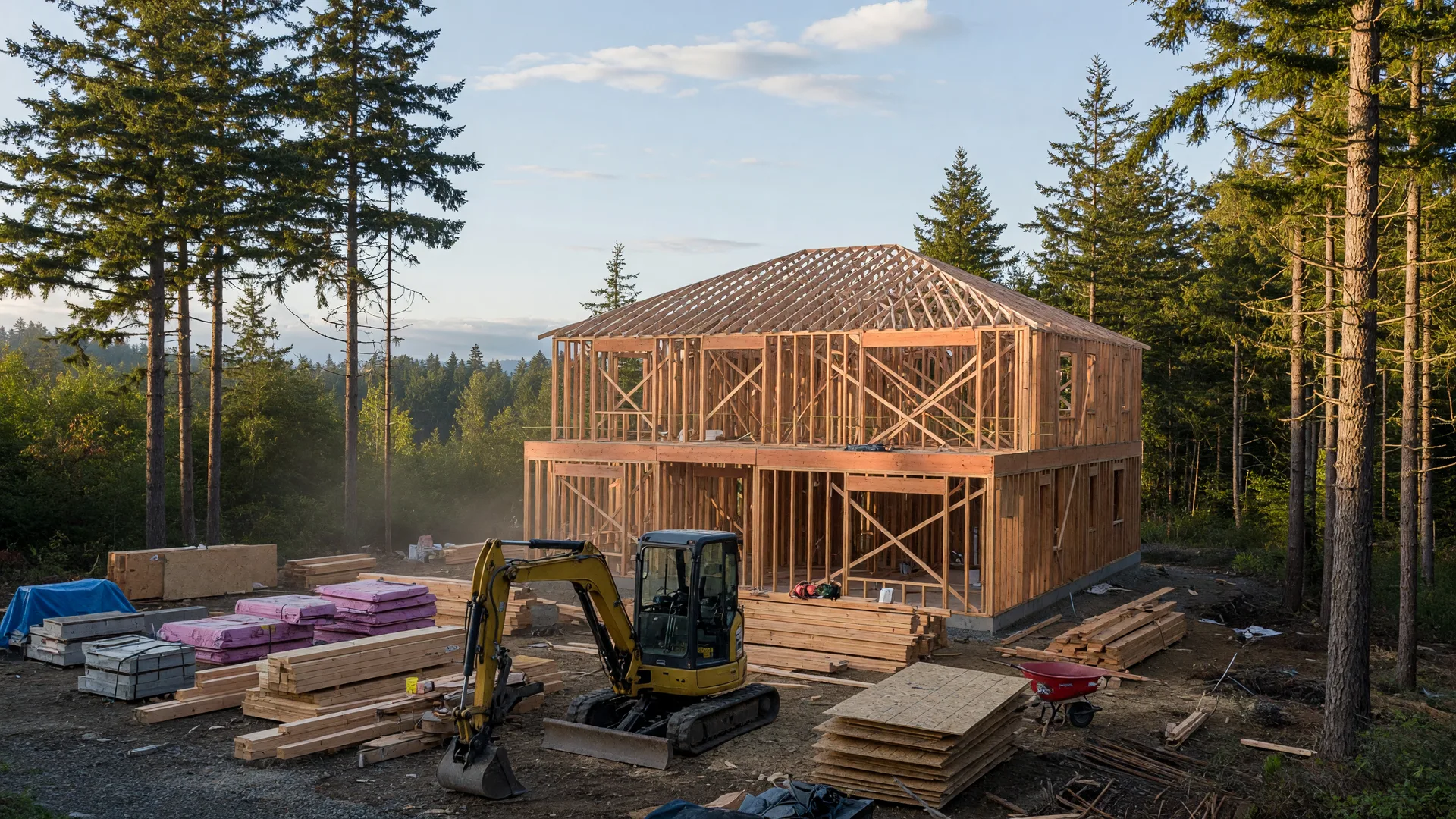
Portland's new construction market is sending mixed signals this year. Overall building permits dropped to levels not seen since the recovery from the Great Recession. But dig a little deeper, and the story gets more interesting. And for buyers who understand what is actually happening, there are real opportunities hiding in plain sight.
What the numbers tell us
Across the Portland metro area, building permits for new homes fell to their lowest count in 15 years. Single-family home starts among the region's top builders pulled back around 4% compared to the prior year. On the surface, that sounds like a market that has gone cold.
But here is what is easy to miss. While detached single-family construction tightened, attached homes -- townhomes, rowhouses, and condominiums -- saw a significant surge in the same period. That is a meaningful shift in what is being built, not a sign that nothing is happening.
Multifamily permitting, meanwhile, hit a 12-year low across Oregon. The combination of higher interest rates, cautious lending, and construction cost uncertainty has made large-scale apartment projects harder to pencil out. Builders are responding by focusing on the product types that pencil best in today's environment: attached homes that deliver better density per square foot of land.
What this means if you want to build
If you are planning to build a custom home or buy new construction in the Portland metro, the current market creates both challenges and openings. Here is what I am seeing on the ground.
Tighter supply of buildable land in desirable areas
In communities like Lake Oswego, West Linn, and Dunthorpe, the urban growth boundary and limited infill parcels mean buildable lots are scarce. New construction that does come to market in these areas tends to land in the luxury segment, with prices reflecting that scarcity. If you are looking to build in one of these established neighborhoods, being ready move on a lot quickly matters.
More attached home options in suburban locations
The surge in townhome and rowhouse construction is concentrated in suburban communities where land is more available and zoning supports higher density. Cities like Oregon City, Tualatin, and Wilsonville are seeing more attached product enter the pipeline. For buyers who want new construction without a custom build timeline, these projects offer a practical middle path.
Rate management matters more than ever
This is the area where I spend the most time with clients. When you are building, the timeline between breaking ground and getting the certificate of occupancy can stretch 12 to 18 months. Interest rates can move significantly in that time. A rate lock that seems reasonable when framing starts might expire before you close.
The traditional approach is to float the rate during construction and lock when the home is near completion. But in a market where rates are fluctuating, that approach creates uncertainty. A one-time close construction-to-permanent loan addresses this by locking both the construction phase and the permanent mortgage in a single closing. You know the terms from the start. That peace of mind is worth a lot when you are already managing builder timelines, draw schedules, and permit inspections.
The construction financing options worth understanding
One-time close construction-to-permanent loans
This is the most straightforward option for most custom builds. You close once. During construction you make interest-only payments on the amount drawn so far. When the home is complete, the loan converts to a standard 30-year mortgage. One set of closing costs. One underwriting process. One rate, locked from the beginning if that is what you choose.
The biggest advantage is certainty. You know your terms before the first foundation pour. If rates climb during construction, that does not affect you. If rates drop, some programs offer a one-time float-down option near the conversion point.
FHA and VA options for construction
A common misconception is that government-backed loans do not work for new construction. In fact, both FHA and VA offer one-time close construction programs. FHA requires as little as 3.5% down, and VA offers zero down for eligible veterans and service members. These programs have their own requirements around builder qualifications and inspection schedules, but they can be a strong fit for buyers who qualify.
Conventional construction financing
For buyers putting 20% or more down, conventional construction-to-permanent loans typically offer competitive rates and more flexibility on loan amounts. This is often the right path for higher-price-point builds in areas like Lake Oswego and Dunthorpe, where custom home costs regularly exceed conforming loan limits.
The hidden piece that most buyers overlook
I have seen this pattern many times over the years. A buyer falls in love with a plan, picks a builder, and starts site work before the financing structure is fully set. By the time the first draw is due, we are playing catch-up.
The most important step in any construction project is the conversation that happens before ground breaks. That is when we look at the full picture: the lot cost, the build budget, the contingency reserves, the draw schedule, the builder's credentials, and how the permanent mortgage will function once the home is done. Getting that framework right upfront prevents almost all of the stressful surprises that show up later.
A note on builder incentives
If you are buying in a new development rather than building custom, you may see builders offering rate buydowns or closing cost credits. Those incentives can be legitimate helpful. But they are not free. The cost of the incentive is built into the purchase price somewhere. My advice is to have your financing independently structured before you negotiate with the builder. That way you know what a fair baseline looks like, and you can evaluate the incentive as a real benefit rather than a reason to overpay for the home.
What is happening locally
In Lake Oswego, new construction remains supply-constrained, which keeps values stable even in a slower market. Recent detached home sales reflect that stability. In Oregon City, developments like Serres Farms offer new detached homes in the mid-to-upper price ranges with good freeway access. And across the metro, attached home projects are filling a gap for buyers who want modern, efficient homes without carrying a custom build timeline.
For buyers targeting West Linn, Tualatin, or Wilsonville, the key is staying connected to what is actually in the pipeline. Much of the new construction activity is not widely advertised. It happens through builder relationships and early connections with lenders who are active in those markets.
Over 35 years, I have learned that the best construction financing does not feel complicated. It feels clear. That clarity comes from starting the conversation early and structuring the loan around the realities of the build, not around a generic product.
If you are considering building in the Portland metro area, I would welcome the chance to talk through your plans. Whether you are looking at a custom home in Lake Oswego, a townhome in Oregon City, or something in between, the right financing structure makes the whole process smoother for everyone involved.
Travis Olson is Area Manager and Senior Loan Officer / Construction Development Specialist at Olson Group at Eureka Mortgage Planning LLC. With over 35 years of experience and an active production practice, he specializes in construction financing, complex transactions, and guiding clients through life-changing mortgage decisions. NMLS #111072 | OR / WA.